


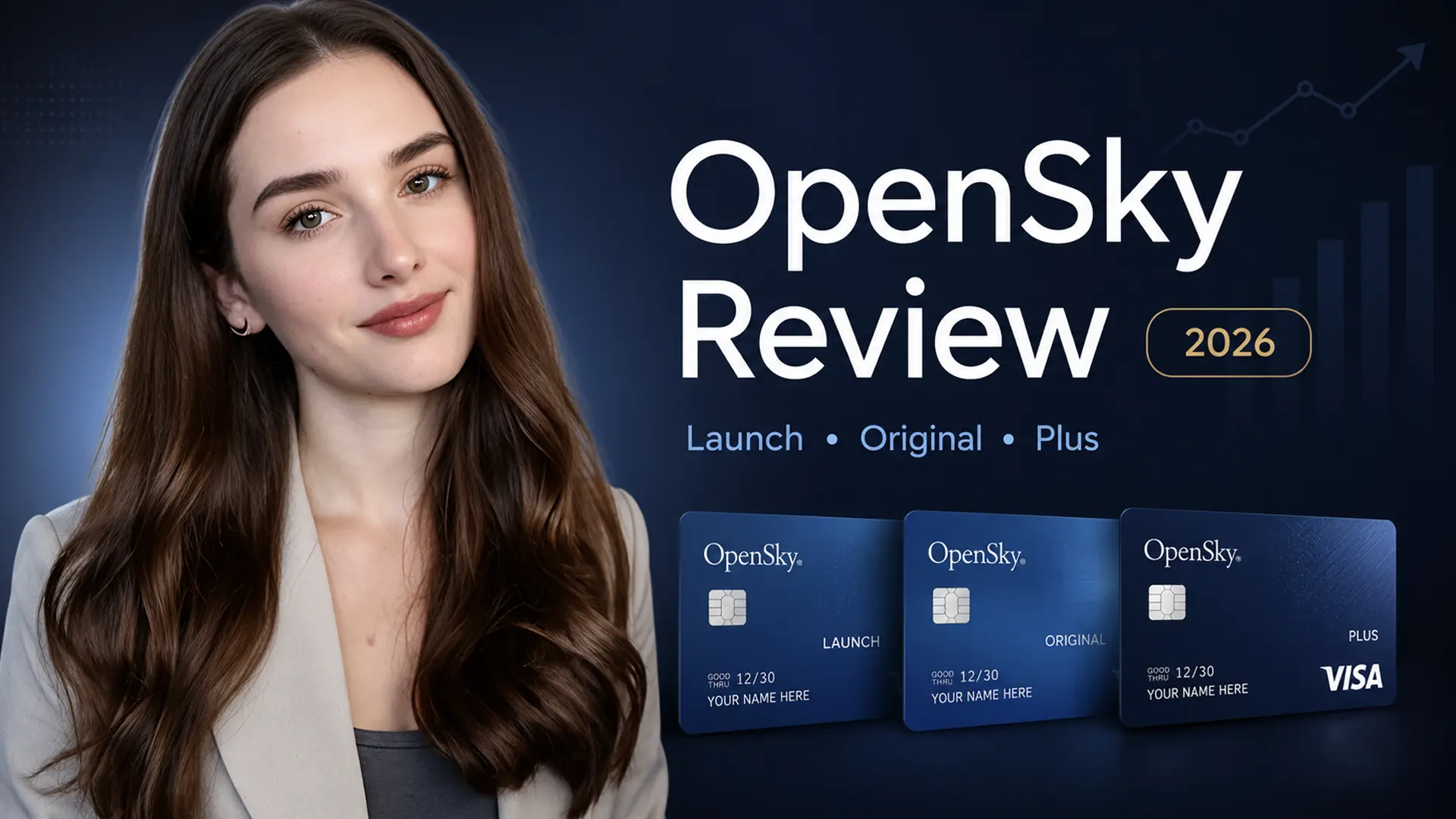
OpenSky Secured Credit Card Review 2026
The OpenSky Secured Visa has been around for years and is one of the better known credit builder cards in the market. The biggest reason is simple: you can apply without a credit check.
That matters for people who have no credit, damaged credit, recent credit problems, or past denials from other banks. OpenSky does not require a hard pull, reports to all three major credit bureaus, and gives users a way to build credit with a refundable security deposit.
But OpenSky is no longer just one secured card.
In 2026, OpenSky has three secured Visa cards:
- OpenSky Launch Secured Visa
- OpenSky Secured Visa
- OpenSky Plus Secured Visa
There is also an unsecured graduation card called the OpenSky Visa Gold.
The best choice depends on one simple thing: how much money you can place as a deposit and how much you care about fees.
Quick Verdict
The OpenSky Plus Secured Visa is the best pick for most people who can afford the $300 deposit because it has no annual fee and no monthly fee.
The OpenSky Launch Secured Visa is better for someone who only has $100 to start, but the monthly fee makes it more expensive over time.
The original OpenSky Secured Visa makes sense mainly for people who want the lowest APR in the OpenSky family and do not mind paying a $35 annual fee.
For credit building, all three cards do the main job: they report to Experian, Equifax, and TransUnion.
OpenSky Secured Cards Compared
| Feature | Launch Secured Visa | Original Secured Visa | Plus Secured Visa |
|---|---|---|---|
| Annual fee | $0 | $35 | $0 |
| Monthly fee | $2 per month in year 1, then $3 per month | None | None |
| Minimum deposit | $100 | $200 | $300 |
| Maximum deposit | $1,000 | $3,000 | $3,000 |
| Variable APR | 28.24% | 23.89% | 28.24% |
| Reports to bureaus | All 3 bureaus | All 3 bureaus | All 3 bureaus |
| Credit check to apply | None | None | None |
| Best for | Lowest starting deposit | Lower APR | No fee long term hold |
The Three OpenSky Cards Explained
OpenSky Launch Secured Visa
The Launch card is the easiest OpenSky secured card to start with because the minimum deposit is only $100.
That is its main advantage.
The downside is the monthly maintenance fee. It charges $2 per month in the first year and $3 per month after that. So even though the card has no annual fee, it is not really free to keep long term.
In the first year, the fee comes to $24. After that, it becomes $36 per year.
This card is best for someone who cannot deposit $200 or $300 right now but wants to begin building credit.
OpenSky Secured Visa
The original OpenSky Secured Visa has a $35 annual fee and a $200 minimum deposit.
At first, that annual fee may look unattractive. But this card has the lowest APR in the OpenSky secured lineup: 23.89% variable.
That makes it the better OpenSky option for someone who is worried about carrying a small balance.
Still, carrying a balance on a secured card is not ideal. If you pay in full every month, APR does not matter much.
OpenSky Plus Secured Visa
The OpenSky Plus Secured Visa is the strongest long term option if you can deposit $300.
It has no annual fee and no monthly fee. That makes it cheaper to keep open than both the Launch card and the original card.
The trade off is the higher starting deposit and the 28.24% variable APR.
For someone who pays the full balance every month, the APR is not the main issue. The bigger benefit is that the card can stay open without ongoing fees.
How OpenSky Works
OpenSky works like a normal secured credit card.
You apply online, fund a refundable security deposit, and your credit limit is usually equal to your deposit.
For example:
| Deposit | Starting Credit Limit |
|---|---|
| $100 | $100 |
| $200 | $200 |
| $300 | $300 |
| $1,000 | $1,000 |
Your deposit is not used to pay your regular purchases. It is held separately. If you close the account in good standing or graduate to an unsecured card, the deposit is returned.
OpenSky says the card usually arrives within around 10 business days.
Once you start using it, you make purchases, receive a statement, and pay the balance. Each month, OpenSky reports your payment history, balance, and credit limit to all three credit bureaus.
That monthly reporting is the main reason people use this card.
Why No Credit Check Matters
The main selling point of OpenSky is that it does not require a credit check for the secured cards.
This can help people who may struggle with approval elsewhere, including those with:
- No credit history
- Very low credit scores
- Recent bankruptcy
- Charge offs
- Thin credit files
- Past denials from traditional banks
OpenSky says its Q1 2025 average approval rate was 89.39%.
That does not mean everyone will be approved. You still need to verify your identity and fund the required deposit. But compared with many secured cards, OpenSky is built for people who may not pass a traditional credit review.
OpenSky Reports To All Three Credit Bureaus
All three OpenSky secured cards report to:
- Experian
- Equifax
- TransUnion
This is important because future lenders may check any one of these reports.
If a credit builder card reports to only one or two bureaus, your progress may not show everywhere. OpenSky avoids that issue by reporting to all three.
OpenSky also says 66% of cardholders raised their score by an average of 47 points within six months of opening the card.
That result is not guaranteed. Your score depends on how you use the card, your past credit history, payment habits, credit utilization, and other factors.
Backed By Capital Bank, N.A.
OpenSky is not just a fintech app with a partner bank behind it.
The card program is from Capital Bank, N.A., a federally chartered commercial bank based in Rockville, Maryland. Capital Bank is FDIC insured, and its parent company, Capital Bancorp, is publicly traded on Nasdaq under the ticker CBNK.
This matters because your secured card deposit is held with a real bank. The account is part of a bank issued card program, not just a temporary credit builder product from a startup.
Capital Bank has been in business since 1999, and OpenSky cards have been issued by its card division since 2008.
For someone who wants stability, that is a useful point in OpenSky’s favor.
Pros Of OpenSky
No Credit Check
This is the biggest reason to consider OpenSky.
You can apply without a hard inquiry. That is helpful if you do not want another credit pull or if your credit history makes approval difficult elsewhere.
Three Card Choices
OpenSky now gives users more flexibility.
If you have only $100, Launch may work. If you have $300 and want no ongoing fee, Plus is better. If you want the lowest APR, the original card is still available.
Reports To All Three Bureaus
Every OpenSky secured card reports to Experian, Equifax, and TransUnion. That is exactly what you want from a credit building card.
Real Bank Issuer
Capital Bank, N.A. is a federally chartered, FDIC insured bank. For a secured card, that gives OpenSky more credibility than many newer credit builder products.
Possible Graduation Path
OpenSky does have a path to an unsecured card.
Eligible cardholders may be invited to upgrade to the OpenSky Visa Gold after roughly six months of on time payments.
This is important because older reviews often said OpenSky had no upgrade path. That is no longer the full picture.
Visa Acceptance
OpenSky cards run on the Visa network, so they can be used widely. The cards also include Visa protections such as zero liability fraud protection and Visa Secure for online purchases.
Cons Of OpenSky
Higher APR On Launch And Plus
The Launch and Plus cards both have a 28.24% variable APR.
That is high. It only becomes a problem if you carry a balance, but if you do, interest can add up quickly.
Fees Depend On The Card
The original card charges a $35 annual fee.
The Launch card has no annual fee, but it charges a monthly maintenance fee. Over time, Launch can become the most expensive secured card in the OpenSky lineup.
No Rewards On Secured Cards
The three secured OpenSky cards do not earn cash back, points, or rewards.
If rewards matter to you, Discover it Secured or Current Build Card may be more appealing.
Foreign Transaction Fee
OpenSky charges a 3% foreign transaction fee on purchases made outside the United States.
That can be costly if you travel internationally or shop on foreign websites.
Mobile App Experience Is Not The Strongest
OpenSky has improved its mobile experience, but it is still not as polished as app first issuers like Discover, Capital One, or Current.
If you want a smooth mobile app experience, this may be a downside.
OpenSky Visa Gold: The Graduation Card
The OpenSky Visa Gold is the unsecured card that some OpenSky users may graduate to.
You cannot apply for it directly. OpenSky may invite secured cardholders after they show consistent on time payments, usually for around six months.
If you graduate, your secured deposit is returned by check.
Key OpenSky Visa Gold details include:
| Feature | OpenSky Visa Gold |
|---|---|
| Security deposit | None |
| Starting credit limit | Around $500 |
| Variable APR | 24.64% |
| Annual fee | $59 |
| Rewards | Up to 10% cash back at more than 40,000 select retailers |
| Application | Invitation only |
The Gold card is not automatically the best next step for everyone.
The $59 annual fee is the biggest drawback. If your credit has improved enough, you may want to compare it with no fee unsecured cards from other issuers before accepting.
Still, the benefit is clear: you may be able to move from secured to unsecured without a fresh hard credit pull.
OpenSky Vs Discover it Secured
Discover it Secured may offer better value for people who can qualify.
It has no annual fee, offers cash back, and has a known path to unsecured graduation.
The issue is that Discover does require a credit check.
So the choice is simple:
Choose Discover it Secured if you can pass the credit check and want rewards.
Choose OpenSky if a hard inquiry or credit review is the main problem.
OpenSky Vs Current Build Card
The Current Build Card is different from OpenSky.
It has no annual fee, no credit check, no minimum deposit, and no APR because you cannot carry a balance in the same way as a traditional credit card.
It also earns points on dining and groceries and reports to all three bureaus.
Current may be better if you want a lower cost credit builder with rewards.
OpenSky may be better if you specifically want a traditional revolving Visa credit card from a bank.
OpenSky Vs Self Visa Credit Card
The Self Visa Credit Card uses a different model.
With Self, you start with a credit builder loan. After building enough savings, you may unlock the Self Visa card.
That means Self can help with both credit mix and card usage.
OpenSky is faster because you do not need to fund a loan first. You apply, place your security deposit, and begin with a secured Visa card.
Self may be stronger for people who want both an installment loan and a card. OpenSky is better for people who want a simpler secured card path without a credit check.
Who Should Get An OpenSky Card?
OpenSky is best for people who need a credit card but may not qualify for traditional approval.
It makes sense if:
- You have no credit history
- You have damaged credit
- You want no hard credit pull
- You can fund a refundable deposit
- You want reporting to all three bureaus
- You want a traditional Visa credit card
- You want a possible path to an unsecured card
OpenSky is less attractive if you want rewards right away, the lowest possible APR, or a polished mobile app.
If you already qualify for a no fee secured card with rewards, OpenSky may not be your best value.
Which OpenSky Card Should You Pick?
Pick OpenSky Launch Secured Visa If
You only have $100 available for a deposit and need to start somewhere.
Just remember that the monthly fee makes it more expensive over time.
Pick Original OpenSky Secured Visa If
You want the lowest APR in the OpenSky secured lineup and do not mind the $35 annual fee.
This is the better OpenSky choice if you may carry a small balance, though paying in full is still better.
Pick OpenSky Plus Secured Visa If
You can fund $300 and want no annual fee or monthly fee.
For most people who can afford the deposit, this is the best OpenSky secured card to keep long term.
Tips To Build Credit With OpenSky
The card itself will not fix your credit. The way you use it matters more.
Keep Utilization Low
Try to keep your balance below 30% of your limit.
If your limit is $200, that means keeping the reported balance below $60.
Below 10% is even better.
Pay In Full Every Month
This is the most important habit.
If you pay the full statement balance every month, you avoid interest. That matters because OpenSky APRs range from 23.89% to 28.24%.
Set Up Autopay
A missed payment can hurt your credit for years.
Set autopay for at least the minimum payment so you do not miss due dates.
Use The Card Every Month
A card that sits unused may not help much.
Use it for one small recurring purchase, then pay it off.
Watch For A Graduation Offer
After around six months of on time activity, you may receive an invitation for OpenSky Visa Gold.
Do not accept automatically. Compare the $59 annual fee, rewards, and your other card options first.
Final Verdict: Is OpenSky Worth It In 2026?
OpenSky is worth considering if your main problem is approval.
It is not the most rewarding secured card. It is not the cheapest secured card for every user. And its mobile experience is not the best.
But it solves one major problem very well: it gives people with weak, limited, or damaged credit a real Visa credit card without a credit check.
For most users, the best OpenSky card is the OpenSky Plus Secured Visa, provided they can afford the $300 deposit. It avoids both the annual fee and the monthly fee, which makes it easier to keep open while building credit.
If $300 is too much, the Launch card gives you a $100 entry point. If APR matters more than fees, the original OpenSky Secured Visa remains the lowest APR option.
Use the card lightly, pay in full, keep utilization low, and treat it as a stepping stone. That is where OpenSky makes the most sense.
